

Monostori Fortress in Komárom: The Most Unexpected Girls’ Day Out on the Danube
Three women. One fortress the size of a small city. A full day of military history — and not a hint of the usual “girls’ day” clichés in sight.
The first thing we noticed wasn’t the cannons, or the uniforms, or even the deep-throated wail of a siren cutting through the air. It was the dust. Not the polite, museum-kind dust. The real kind that clings to your shoes, sneaks into your cuffs, and makes you feel like you’ve stepped into a place that still remembers boots marching in formation.
That’s when we looked at each other and laughed. Three women. One fortress the size of a small city. A full day of military history. And not a hint of the usual “girls’ day” clichés in sight.
We’d started our autumn with a simple plan: a few weekend outings, something different, something that didn’t involve shopping bags or the same restaurants we could find on any boulevard. Then it escalated the way the best obsessions always do. One shelter tour turned into another. A World War exhibit led to a live demonstration. Somewhere along the line, Budapest became the warm-up act, and our weekends became a rolling itinerary of concrete corridors, subterranean rooms, and stories that refuse to stay in the past.
Komárom was the day it clicked. Not as a one-off visit, but as a new category of travel altogether.

Arriving At Komárom

Between The Letters

Sign Of The Place

Autumn Approach
Komárom Isn’t One City, It’s a Borderline Story
Komárom has a strange, magnetic quality because it isn’t just a place on the map. Historically, it was one city that grew along both banks of the Danube. Today, it’s divided by a border: Komárom on the Hungarian side, Komárno on the Slovak side. You can feel that split in the way the river behaves here, less like a scenic detail and more like a living seam holding two identities together.
That geography explains everything that came next. A city at a river junction and a key crossing point becomes a city that armies care about. It becomes a place where fortifications layer over one another across centuries, because the location never stopped mattering. Romans understood it. Medieval rulers understood it. Empires and occupying armies understood it. And if you spend a day at Monostori Fortress, you’ll understand it too, even if you arrive mostly for the spectacle.

The Danube From The Fortress

Komárno Across The Water

A River That Shapes Cities

Looking Across The Border
The Monostori Fortress Effect: You Don’t See It, Then You Can’t Unsee It
Monostori Fortress sits along the Danube, and from the outside it can feel almost modest, as if it’s playing coy. That’s the trick. This is a 19th-century giant designed to be hard to read from a distance, built with thick earth cover and military logic that favored survival over grand facades. Then you walk in, and the scale hits you like a cold draft in a tunnel.
Monostori is part of the wider Komárom fortification system, but it feels like its boldest statement: a self-contained military world with long corridors, layered defenses, and spaces that once served as barracks, stables, storage, and the kind of infrastructure you need if you’re planning to hold a strategic point against serious pressure.

Modest From The Outside

Then The Scale Hits

Light Cuts The Dark
There’s a particular romance to a fortress like this, but it isn’t candlelit and gentle. It’s the romance of distance and echo, of massive brickwork, of shadows that stretch, of doors and corners that keep suggesting there’s more you haven’t seen yet.
Our Day Turned into a Festival of Living History
We arrived on a crisp, sunny fall day, the kind of weather that makes you grateful for a light jacket and a good pair of shoes. Late October or early November, if we had to pin it down. Not warm, not cold, just perfect for walking until your legs start negotiating.

Festival Atmosphere

Reenactors In Formation

Moving In Ranks

Market And Marquees
The main attraction that day was a World War II-themed military event, the kind where “exhibition” doesn’t mean glass cases and whispering. It means tents, gear, vehicles, uniforms, re-enactors who actually know what they’re talking about, and a constant hum of movement. We were invited by a serious U.S. Army enthusiast we’d met at another event, someone who didn’t just dabble in the hobby but arrived with a full setup, a real presence, and the kind of excited authority that makes you want to follow them from station to station just to catch the details you’d miss alone.
It was loud in the best way. There were moments when the soundscape did the work for you: the far-off blast of a demonstration, the metallic clink of equipment, voices drifting across the yard, and then that siren again, pushing the whole crowd into a collective, instinctive attention.

T-34 On Display

History Up Close

Scale You Can Stand Next To
We watched a mix of displays and demonstrations that moved between the ground and the sky. Vehicles. Equipment. A sense of scale you don’t get from documentaries. If you’ve ever binge-watched war films and thought, “Sure, but what would it feel like to stand near that?” this is the kind of day that answers the question.
And yes, we shopped. Because nobody walks past tables of replicas and period-style souvenirs without at least pausing. The market energy is part of the fun. It turns a history site into something more social and strangely contemporary: people trading stories, comparing notes, hunting for details, asking questions, laughing. It’s educational, but it’s also play. Serious play, sure, but play.
When the Noise Got Too Much, the Fortress Took Over
At some point, after the crowds and the sound and the constant stimuli, we did what felt natural: we escaped into the fortress itself.
This is where Monostori changes mood. The open areas are lively, but the interior is something else. Long corridors wrap and run. Two main wings create a sense of a fortress-within-a-fortress, and between walls you start noticing the defensive logic: spaces meant to slow you down, channel you, protect the core.

Corridors That Run Forever

Light At The End

Windows In The Wall

A Channel Of Light
Wear shoes you don’t love. The dust is real, and so is the grit. Bring layers, because the interior stays cool even when the outside feels mild. And if you’re even slightly wary of dim spaces, bring a flashlight. On a bright day, there’s enough ambient light in places, but a flashlight turns the experience from “careful shuffle” into “confident exploration.”
If you want one piece of practical advice that isn’t negotiable, it’s this: wear shoes you don’t love. The dust is real, and so is the grit. Bring layers, because the interior stays cool even when the outside feels mild. And if you’re even slightly wary of dim spaces, bring a flashlight. On a bright day, there’s enough ambient light in places, but a flashlight turns the experience from “careful shuffle” into “confident exploration.”

Empty Chamber

Deeper Into The Wing

Silhouettes Of Those Who Stood Here
We walked. We climbed. We passed through corridors that made us whisper without planning to, as if the brickwork itself asked for it. We found ourselves looking for small signs of the lives that once filled these rooms. Not just soldiers as figures in history, but soldiers as people who slept, ate, waited, joked, wrote on walls, got bored, got scared, and got on with it anyway.
There’s a line associated with the fortress that captures the mood perfectly: if you haven’t been here, you don’t know; if you have been here, you don’t forget. Monostori has that kind of stickiness. It’s not just impressive, it imprints.
A Fortress Built for Empires, Repurposed for Curiosity

Komárom’s fortification story reaches deep. The area’s strategic importance goes back through layers of settlement and conflict, and by the 19th century the stakes were enormous. The Napoleonic era pushed imperial planning into overdrive, and later the 1848–49 revolution and its aftermath shaped how the defenses evolved. Monostori, as we see it today, grew from that world of imperial engineering and political tension: a fortress designed to endure, to protect crossings, to hold a line.
Then the 20th century arrived and the story darkened. Monostori became wrapped in secrecy during the Soviet era, tied to the Cold War and the kind of military logistics that leaves rumors in its wake. That’s part of the modern fascination. Some claims live more as legend than as proven archive fact, but even the presence of those legends tells you something: places that feel ordinary don’t accumulate myths. Places that feel powerful do.

Where Nature Returned

A Glimpse Outside

Curated Corridor

Passage To Daylight
What’s striking now is the shift. The fortress today isn’t a passive ruin. It’s curated, interpreted, and often activated through exhibitions, guided routes, interactive programs, and large-scale events that pull in everyone from families to hardcore reenactment fans. That’s why your trip can feel completely different depending on the weekend you choose.
The Rooftop Moment: Danube Wind, Slovak Skyline
After hours underground, we made our way upward. Every fortress has that payoff moment when you finally reach a higher point and realize how the whole landscape fits together.
From above, the Danube becomes the main character. The river’s curve and width, the feeling of proximity to Slovakia, the sense that this isn’t just scenery but an old route for trade, armies, and ideas. You stand there and understand why the builders cared so much about sightlines, about range, about control.
It’s also simply beautiful. The kind of view that makes your photos look like you planned them, even if you were just chasing good light and fresh air after too many corridors.

Komárno On The Horizon

From The Rampart Top

Sunlit Earthworks
Planning Your Visit: How to Make This Day Actually Feel Effortless
Monostori Fortress can easily take half a day even without an event. With a major program on, you can spend a full day without noticing the time. The secret to enjoying it is simple: treat it like a small expedition.

A Day Worth Planning

As Light Turns Golden

A Quiet Window Out
If you’re traveling from Budapest, you’ll want a plan that keeps the day smooth. This is exactly the kind of trip where private transportation quietly improves everything. You don’t have to think about timetables. You don’t have to carry every extra layer all day. You can keep a change of shoes in the trunk, swap out dusty sneakers after the tunnels, and step back into the city feeling like a human again.
A comfortable transfer changes the experience from “logistics” to “adventure.” The driver waits while you roam, you keep your day flexible, and you arrive back in Budapest without the end-of-day scramble. VanBudapest.com — Since 1988 makes these day trips feel simple.
That’s why, when we recommend making Komárom part of your Hungary itinerary, we say it plainly: a comfortable transfer changes the experience from “logistics” to “adventure.” VanBudapest.com — Since 1988 makes these day trips feel simple without turning the article into an advertisement. The driver waits while you roam, you keep your day flexible, and you arrive back in Budapest without the end-of-day scramble.
Why This Works as a “Girls’ Day” and Why That Even Matters
We kept noticing the same thing throughout the day: people assumed we were tagging along with someone. A boyfriend. A brother. A dad. The truth was funnier and better. We were there because we wanted to be.
There’s something satisfying about choosing a place that surprises people. About turning curiosity into a plan. About walking into a traditionally male-coded space and refusing to perform any role except “interested visitor.”

Standing Tall On The Armor

Closer Than Expected

Where Curiosity Leads
Monostori is perfect for that. It’s tough and tender at once: heavy brick and open sky, war stories and quiet corners, crowds and solitude. You can geek out over equipment, then drift into corridors that feel like a different century, then step outside and take photos that look like a fashion editorial if you catch the light right.
The best travel days aren’t always the prettiest. They’re the ones you can still describe in detail months later. The ones that leave dust on your shoes and a weird kind of happiness in your voice when you tell the story.
And if you’re reading this in spring, thinking about how the year suddenly feels wide open again, take the hint we took from ourselves: start filling weekends with places that have real character. Fortresses. Caves. Mining museums. Shelters. The kind of sites that make you feel awake.
Keep an Eye on the Calendar: Events Are Half the Magic
One last practical note, because it matters. This fortress doesn’t just sit there waiting politely. It hosts. It changes. It turns into a stage for everything from historical weekends to major festivals, and the best way to time your visit is to check the official program listings before you go.

When Tanks Roll Out

Tank Drives The Yard

Jeep, Gun, And Bridge

The Bridge In The Background
If you want the fortress at its most atmospheric and quiet, choose a calmer day and focus on the interior routes. If you want the full sensory overload, aim for an event weekend and let the place do its loud, theatrical thing.
Either way, you’ll leave with a story.
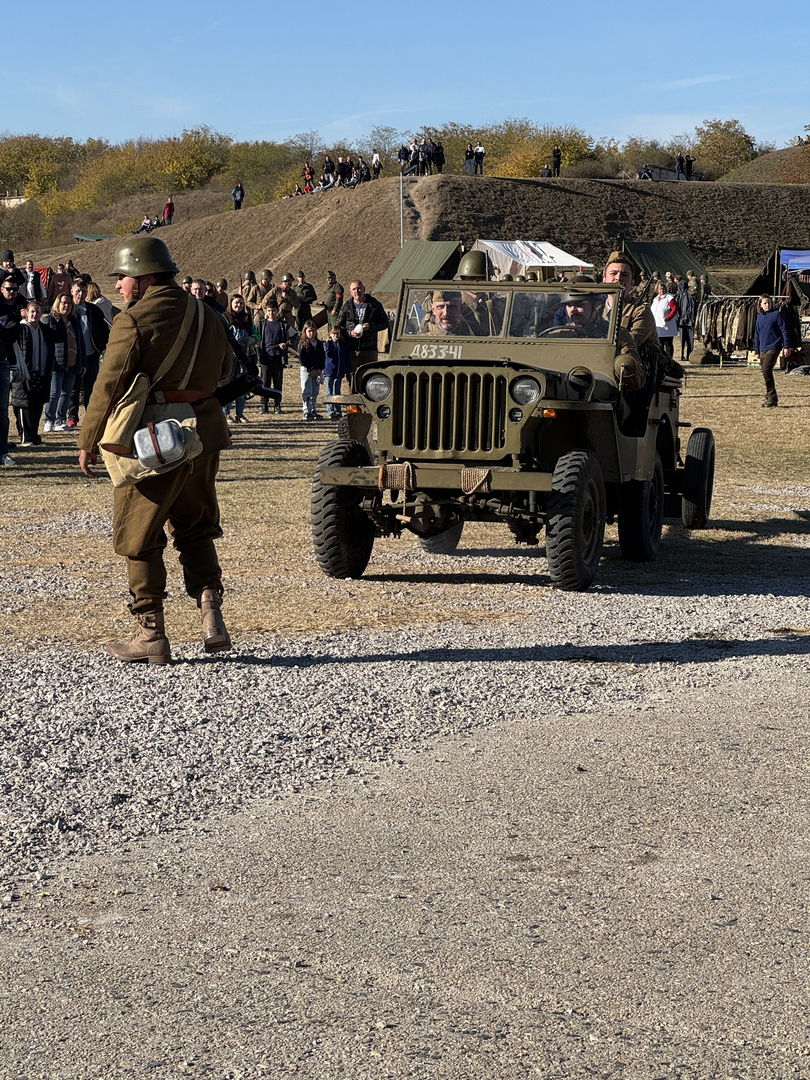
Action On The Ground

Soldier And Crowd

The Walk Back Through Autumn

The Patrol Boat Display
Field Manual: Frequently Asked Questions
What is the Monostori Fortress, and why is it famous?
Monostori Fortress is a massive 19th-century military fortress in Komárom on the Danube, built as part of the wider Komárom fortification system. It’s known for its monumental scale, long casemate corridors, and layered history from imperial defense planning through the Cold War era.
How much time do you need to visit Monostori Fortress in Komárom?
Plan at least half a day for Monostori Fortress, even on a normal day. If there’s a major event or reenactment program, a full day is easy to fill without rushing.
What should I wear to Monostori Fortress?
Wear closed-toe shoes you don’t mind getting dusty, and bring layers. The interior corridors and casemates can be cool even when the weather outside is mild. A flashlight is a smart add-on if you want to explore confidently in dim areas.
Is Monostori Fortress a good day trip from Budapest?
Yes. Komárom is an easy day trip from Budapest, especially if you want a mix of history, Danube scenery, and occasional large-scale events. A private transfer makes the day smoother because you can travel on your own schedule and keep extra layers or a change of shoes with you.
Sources & Further Reading
For deeper research, official program listings, ticket information and historical context, consult the verified sources below.

Make Komárom Part Of Your Hungary Itinerary
From Budapest to the Danube fortress and back — on your own schedule, with a private driver who waits while you explore. No timetables. No logistics stress. Just the adventure.
Book Your Komárom Day TripVanBudapest.com — Since 1988