

The Hungarian parliamentary election of 12 April 2026 stands as one of the most consequential political events of the post-1989 era. In a single day, voters produced a change of government, a realignment of the party system, and a potentially regime-altering constitutional moment — sending a signal far beyond the country’s borders about the resilience of democratic contestation in Central Europe.
The Respect and Freedom Party (Tisza), led by Péter Magyar, secured a historic two-thirds majority in the 199-seat National Assembly, bringing to an end sixteen uninterrupted years of Fidesz–KDNP rule and the order widely described in the international literature as an “illiberal democracy” or “electoral autocracy.”
Turnout approached 80 per cent — among the highest since the democratic transition — the product of a heightened sense of political stakes, deep social polarisation, and the mobilisation of voters expecting a change of government. The result reshapes Hungarian domestic politics from the ground up and has immediate implications for the internal balance of the European Union, NATO and the wider transatlantic community, given Hungary’s previous “maverick” role within the EU and its prominent ties with Russia.
IExecutive Summary
All available data indicate that the Tisza Party won decisively, securing approximately 53 per cent of the list vote, against 38–39 per cent for Fidesz–KDNP and 5–6 per cent for Our Homeland; no other party cleared the 5 per cent threshold.
This translated into 141 Tisza, 52 Fidesz, and 6 Our Homeland seats in the 199-member parliament, a mandate that substantially exceeds the two-thirds constitution-amending threshold of 133 seats.
The Fidesz–KDNP dominant-party system that had been in place since 2010 — characterised by much of the international literature as a “hybrid regime” or “electoral autocracy” — was dismantled in institutional terms in a single day, even though the personal and economic networks tied to the System of National Cooperation (NER) remain deeply embedded.

It follows that the 2026 election has regime-changing potential, but does not in itself guarantee the consolidation of liberal democracy: the success of the transition will depend on the institutional and political choices of the coming years.

IIBackground to the Election
The State of the Political System Before 2026
Under continuous Fidesz rule since 2010, the Hungarian political system gradually drifted away from classical liberal democracy and increasingly came to resemble a “hybrid regime” or “electoral autocracy” — a system in which elections are formally free but not fair. Fidesz’s two-thirds majority in 2010 enabled the adoption of a new Fundamental Law, the redesign of the electoral system, the installation of pro-government appointees at the head of independent institutions, and the construction of foundation-based structures managing public assets.
The political science literature describes Fidesz as a “hybrid” formation combining movement-like, clientelistic and cartel-party features, built on continuous mobilisation, strong leader-centredness, and extensive resource control. Within the media system, the state news agency, public-service broadcasters and pro-government private media conglomerates together formed a structure in which the governmental narrative dominated, while the independent press was largely pushed into the online sphere.
The Principal Conflicts of the Previous Term (2022–2026)
Rule-of-Law Disputes with the EU
The European Commission, through several procedures — including the rule-of-law conditionality mechanism — suspended the disbursement of billions of euros in EU funds to Hungary, citing corruption, opaque public procurement and the erosion of judicial independence. The freezing of funds markedly worsened Hungary’s growth prospects and narrowed the government’s room for manoeuvre, fuelling social discontent.
The Russo–Ukrainian War and Hungarian Foreign Policy
Viktor Orbán’s government continued to maintain close energy ties with Russia after the war broke out, criticised the EU’s sanctions policy, and repeatedly blocked EU financial packages and military support for Ukraine. This line produced sharp conflicts with numerous EU and NATO allies and intensified domestic debate over Hungary’s geopolitical orientation.
Economic Crisis, Inflation and Social Protests
The after-effects of the Covid-19 pandemic, the energy crisis and the inflation shock pushed Hungary’s inflation rate into the highest range in Europe during 2022–2023; real wages fell substantially and the forint slid to repeated historic lows. Protests, strikes and demonstrations among teachers, health workers and other sectors reflected the under-financing of the public sphere and a growing crisis of trust in the government.


The Rise of the Tisza Party
The Tisza Party emerged as a movement organised around former Fidesz-adjacent insiders and civic figures, catapulted to national prominence by Péter Magyar’s personal story — a public break with the government and a vocal anti-corruption stance. In a matter of months, the party built a national network through signature campaigns, mass rallies and intense online presence; early polling showing 10–15 per cent support rose past 30 per cent by the end of 2025.
By the final weeks of the campaign, Medián and other independent research institutes were signalling the possibility of a two-thirds Tisza victory, particularly given the striking level of commitment in the “certain-voter” category. Meanwhile, Fidesz support gradually eroded, while for the former opposition parties (DK, Momentum and others) it became increasingly clear that the “change-of-government voter” identity was no longer tied to them.
IIIElection Day — 12 April 2026
Election day unfolded in a calm but highly mobilised atmosphere. Polling stations reported a steady inflow of voters from the early morning, with long queues in Budapest and in several major regional cities; diaspora voters in Western Europe, North America and Australia turned out in record numbers by postal ballot and at consulates.
The National Election Office certified turnout at approximately 79.6 per cent of eligible voters by the close of polls — the highest participation figure since the democratic transition, exceeding the 2022 figure by nearly ten percentage points. Independent observer missions from the OSCE/ODIHR and the European Parliament deployed teams in every county; their preliminary statements praised the professionalism of polling-station staff while noting the unequal media environment and the continuing weight of state advertising in the pre-campaign period.

IVThe Results in Detail
| Party | List vote | Seats | Change vs. 2022 |
|---|---|---|---|
| Tisza (Respect & Freedom) | ~53% | 141 | New supermajority |
| Fidesz–KDNP | 38–39% | 52 | −83 seats |
| Our Homeland (Mi Hazánk) | 5–6% | 6 | ±0 |
| Democratic Coalition & allies | <5% | 0 | Wiped out |
| Others / below threshold | ~2% | 0 | — |
The territorial picture was equally decisive. Tisza won the overwhelming majority of single-member constituencies in Budapest, the larger regional centres (Debrecen, Szeged, Győr, Pécs, Miskolc, Székesfehérvár) and the county seats across Transdanubia. Fidesz retained a strong base only in parts of the eastern and southern countryside, small towns and certain Trans-Tisza regions. Our Homeland held on to a handful of specific rural and former heavy-industry constituencies.
Compared with 2022, the shift is of epoch-making magnitude: the Fidesz electoral coalition lost roughly a quarter of its 2022 vote, while Tisza — a party which did not even exist in its present form in 2022 — took nearly every vote the old left-liberal opposition had previously received, plus a sizeable slice of moderate, anti-corruption-minded former Fidesz voters.

Hungary has returned to Europe’s community of values — yet the real test of regime change is not election night, but the institutional choices of the years to come. Van Budapest Review · Deep Research Desk
Election Night in the Capital
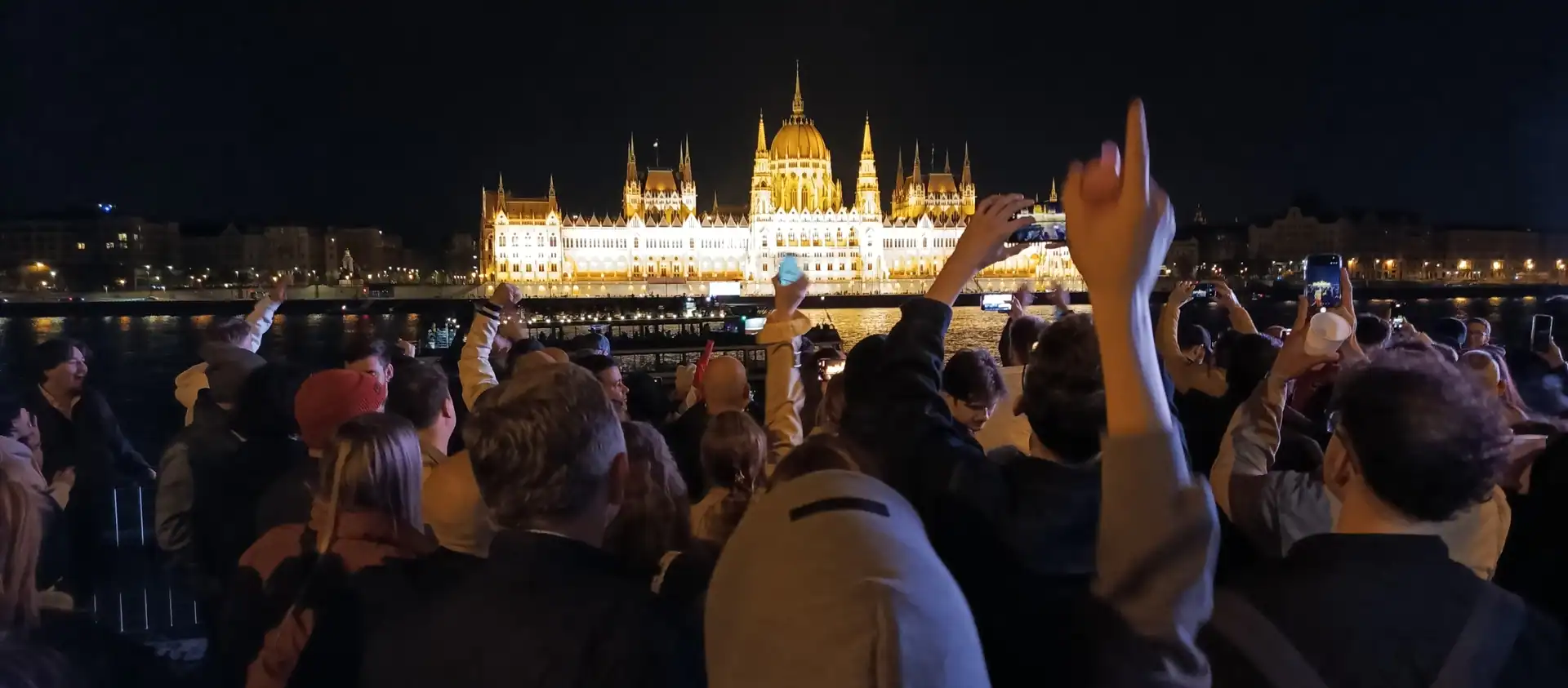
By the time the final results were certified in the early hours of 13 April, Budapest had already entered a night unlike any in recent memory. From the Danube embankments to the inner districts, crowds formed and reformed around large screens and impromptu stages; trams rerouted, cafés extended their hours, and district-level announcements were met with applause rather than silence. What follows is a brief visual record of the capital on the night the political map of Hungary was redrawn.


VThe Position of the Political Actors
Tisza Party
The immediate post-election task for the Tisza leadership is to translate the electoral mandate into a functioning, competent government. Péter Magyar’s rhetoric of “fresh start,” a politically unaligned administration and technocratic governance is now meeting the hard realities of a ministerial system, cardinal legislation and EU-aligned policy-making. The party faces the classic challenge of all movement-origin formations: to mature into a stable parliamentary party without losing the moral capital that carried it into power.

Fidesz–KDNP
For Fidesz the task is to rebuild a 52-seat opposition caucus into a credible alternative government within the standard four-year cycle, in an environment where the media ecosystem around the party, the foundation-based economic network, and a substantial part of its personnel universe are now in a defensive posture. Any serious renewal will involve generational change, a rebalancing of the party’s relationship to its most controversial foreign-policy positions, and a recalibrated relationship with Brussels.
Our Homeland (Mi Hazánk)
Our Homeland’s six-seat caucus occupies an unusual space: simultaneously to the right of the incoming government on cultural and identity issues and to the right of Fidesz on several “sovereignist” economic questions. Its parliamentary behaviour will largely determine whether the new opposition landscape consolidates into a two-and-a-half-party system (Tisza / Fidesz / Our Homeland) or fragments further.

The Former Opposition
For the Democratic Coalition and the other post-2010 left-liberal formations that fell below the threshold, the 2026 election is an existential event. They now face a choice between dissolution, merger, or a fundamental programmatic reinvention — possibly as explicitly European, social-liberal or green partners within a broader Tisza-aligned bloc.
VIInternational Reactions
Western capitals responded with a mixture of relief and measured optimism. The European Commission welcomed “the democratic vitality demonstrated by Hungarian citizens” and underscored its readiness to open a new chapter in the EU–Hungary relationship once the agreed reform milestones are met. Leaders in Berlin, Paris, The Hague, Warsaw and the Nordic capitals framed the outcome as a reaffirmation of the European project in Central Europe.

NATO and the US administration signalled the importance of restoring a fully aligned transatlantic posture, while avoiding any impression of interference in the coalition-building phase. Several major international newspapers used front-page language explicitly framing the result as “a win for Europe” and as evidence that the illiberal wave of the previous decade was not irreversible.
Russia reacted cautiously but with evident disappointment; analysts concur that the Kremlin has lost one of its most important EU allies, even as Moscow pledged pragmatic dialogue with the new government. Kyiv, by contrast, welcomed the prospect of a Hungarian government prepared to unblock European support packages and reopen serious cooperation on regional security.
VIIGeopolitical Dimensions
The election result rebalances several dossiers simultaneously. Within the European Council, Hungary had been the most reliable vehicle for blocking consensus on Ukraine-related decisions, on migration and on rule-of-law instruments; with a pro-European Tisza administration, Budapest is expected to shift from veto player to constructive partner on most questions.
Within NATO, the new government is expected to reaffirm Alliance solidarity in concrete terms — on Ukraine support, on air-policing commitments and on defence-spending targets — ending a period in which Hungary’s position had diverged from that of most member states.
Regionally, the result affects the Visegrád dynamic. With Poland’s current pro-European government, a Tisza-led Hungary and a more pragmatic Slovakia, the V4 format could revive as a coordination forum within the EU rather than an ideological counterweight to it. The Western Balkans enlargement file, long hostage to individual veto politics, also becomes easier to move forward.
VIIIRule of Law and EU Funds
The EU is withholding some €17–18 billion in support over concerns relating to the rule of law and corruption; the Commission has tied the release of the funds to the fulfilment of a 27-point “super-milestone” package. Immediately after the election, Péter Magyar signalled his intention to join the European Public Prosecutor’s Office, strengthen the independence of the judiciary, and overhaul the state media, expressly in order to accelerate the unfreezing of EU funds.
Brussels technocrats are preparing an accelerated assessment track that could see a first tranche unlocked within months if legislative milestones are reached. The macroeconomic implications are significant: a restored EU-funds pipeline would support the forint, reduce sovereign-borrowing costs, and give the new government fiscal space to honour campaign pledges on health, education and public-sector wages.


IXInstitutional Cohabitation
Tisza’s two-thirds mandate makes it possible to amend the Fundamental Law, the cardinal (two-thirds) laws, and the regulatory frameworks of the judiciary and the media. At the same time, the leadership of key institutions — the President of the Republic, the Constitutional Court, the state media, and several “public-interest asset-management foundations” — remains in the hands of figures aligned with the Orbán system, foreshadowing a conflict-laden, protracted “institutional cohabitation.”
Much of the legal-academic debate in the coming months will centre on the question of how far the new majority can and should reach: whether to pursue a “fast-track” constitutional restoration using the two-thirds toolkit itself, or to proceed more gradually via a combination of ordinary legislation, European law alignment and targeted constitutional amendments only where necessary.

XSocial and Discursive Consequences

The record turnout points both to a broad mobilisation of political participation and to deep social fragmentation: the campaign was characterised by an intense narrative war, disinformation operations, and personalised character assassination.
Online, the election marked a breakthrough for social-media-driven political mobilisation: Tisza’s TikTok, YouTube and Facebook campaigns successfully offset Fidesz’s traditional media dominance. Short-form video proved decisive among first-time voters and the 18–29 cohort.
Social expectations are euphoric in the pro-change camp (“liberation,” “taking the country back”), while Fidesz voters are experiencing a sense of loss and uncertainty. In the longer term, this will shape political trust, the legitimacy of public institutions, and the quality of democratic culture.

XIScenarios for the Short, Medium and Long Term
The concluding chapter of any serious post-election analysis must resist the twin temptations of triumphalism and catastrophism. Three broad scenarios can be laid out for the coming years, each anchored in observable institutional variables.
Optimistic · “European Hungary”
The new majority executes a disciplined, milestone-compliant reform programme; EU funds are unlocked in tranches; the forint stabilises; judicial independence is restored in law and in practice; and Hungary becomes a constructive voice within the EU and NATO. Democratic institutions consolidate around pluralism rather than majoritarian discipline.
Realistic · “Difficult Transition”
Significant reforms are adopted but implementation is uneven; “institutional cohabitation” produces visible friction; some EU funds are released but not all; economic recovery is real but slower than campaign promises suggested; and opposition consolidation around Fidesz renewal or a new right-wing formation gathers pace toward 2030.
Pessimistic · “Contested Restoration”
Reform momentum stalls in the face of institutional resistance and economic headwinds; political polarisation deepens; a Tisza administration is tempted by its own two-thirds toolkit to entrench advantages; and the post-1989 question — what kind of democracy Hungary wants to be — remains unresolved into the next electoral cycle.
XIIConclusion

The 2026 election has delivered a mandate of historic scale, and with it a responsibility commensurate with that scale. The institutional architecture constructed over the preceding decade cannot be unwound in a single parliamentary term, nor should any responsible government attempt to do so in a manner that would merely invert, rather than dismantle, the logic of majoritarian capture.
What the election clearly has done is to reopen the political field. Hungarian democracy, at the close of 2026, is no longer a closed question. Whether it becomes a consolidated, European, liberal democracy of the 21st century is a question that will be settled not on election night, but in the thousands of legislative, administrative and judicial decisions of the coming years — and, ultimately, at the ballot box in 2030.
For observers in Brussels, Washington, Berlin and beyond, the Hungarian case will continue to serve as a laboratory of European political development: first as a cautionary tale about the fragility of liberal institutions, and now — one hopes — as a study in how a European democracy can reassert itself through the ordinary means of free elections and citizen mobilisation.